Step-by-step instructions for specific services: Bitrix24, amoCRM, Travelline, Bnovo, MEWS, payments, databases.
Each service connects with its own fields: one needs a key, another an OAuth sign-in, a third a hotel ID. Expand the row you need — inside you’ll find what you’ll need, the steps, and how to check that it works.
General order for any talent: click the card on the Talents tab → sign in to the service or paste an API key → review the list of available tools → spell out in the Persona when the employee uses them → test in the test chat.
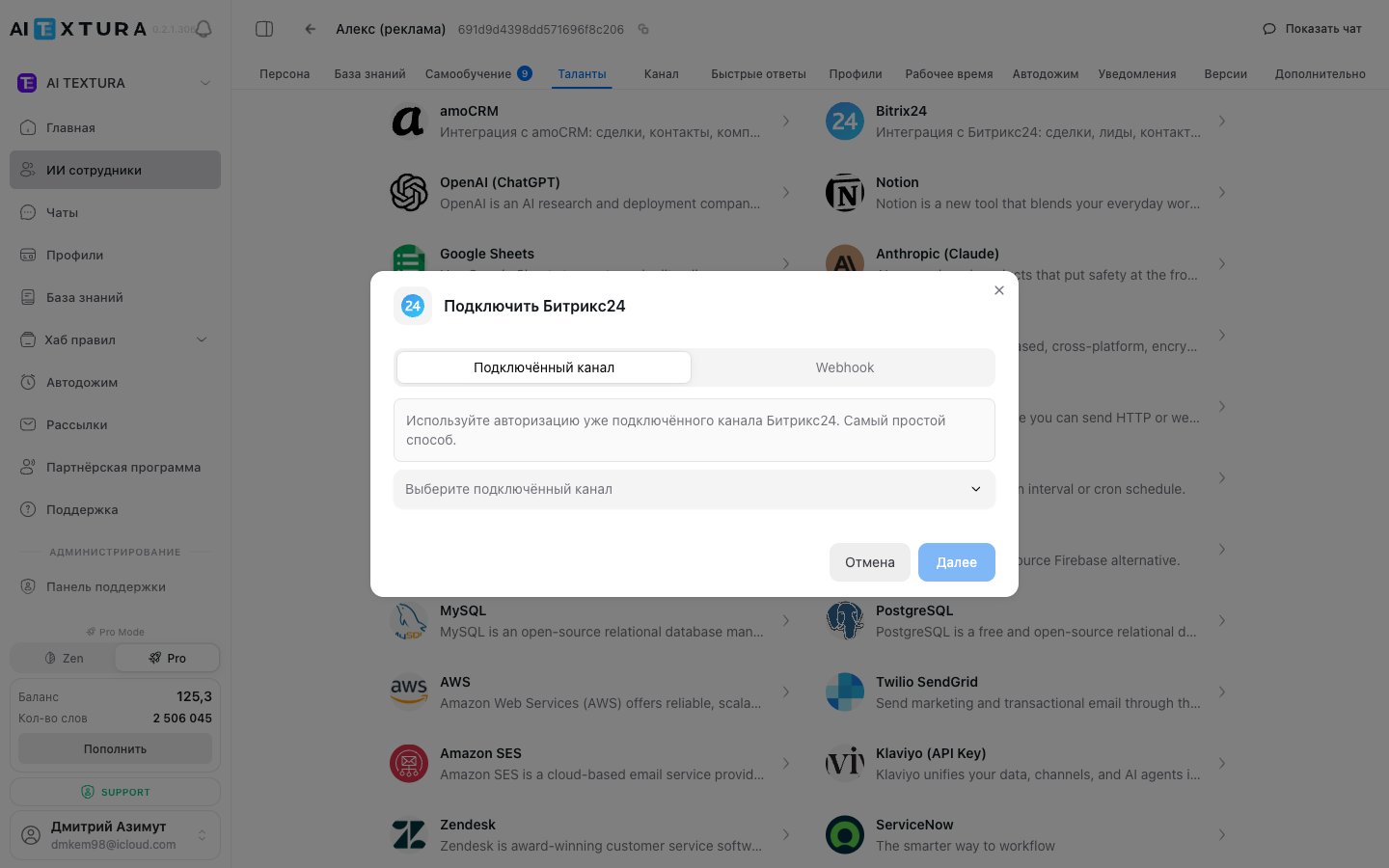
Bitrix24 appears on the platform twice: as a channel, so messages from Open Channels arrive in AI TEXTURA chats, and as a talent, so the employee can create leads and deals, look up contacts, and assign tasks. These are two independent connections, and you usually need both.Click the Bitrix24 card in the catalog and choose a tab.
Via a connected channel
Via an inbound webhook
The shortest path: the talent borrows the channel’s authorization, so you don’t need to create a separate webhook.
1
Choose a channel
The list shows Bitrix24 channels already connected to your organization.
2
Click Next
The talent gets the channel’s permissions and appears on the Connected subtab.
The list is empty if no Bitrix24 channel is connected yet. In that case, connect the channel or use the webhook option.
Use this when you don’t use the channel or the talent needs a separate set of permissions.
1
Create a webhook in Bitrix24
Applications → Developer resources → Other → Inbound webhook.
2
Select permissions
You need all six: CRM (crm), Users (user), Tasks (task), Chat and notifications (im), Creating and managing chatbots (imbot), Open Channels (imopenlines).
3
Copy the webhook URL
It looks like this: https://your-portal.bitrix24.ru/rest/1/abcdef0123456/.
4
Paste the URL into AI TEXTURA
Go back to the Bitrix24 talent window, paste the URL into the field, and click Connect.
Check. In the test chat, write: “I’d like to submit a request, my name is Ivan, my phone is 900-000-00-00.” A deal or lead with this data should appear in Bitrix24.If it doesn’t:
The employee replies, but the CRM is empty — the Persona has no rule for when to create a deal. Add it explicitly.
The action fails — the webhook doesn’t have the CRM permission. Recreate the webhook with all six permissions.
It worked and then stopped — the webhook was revoked on the Bitrix24 side. Create a new one and paste the URL again.
How to connect amoCRM
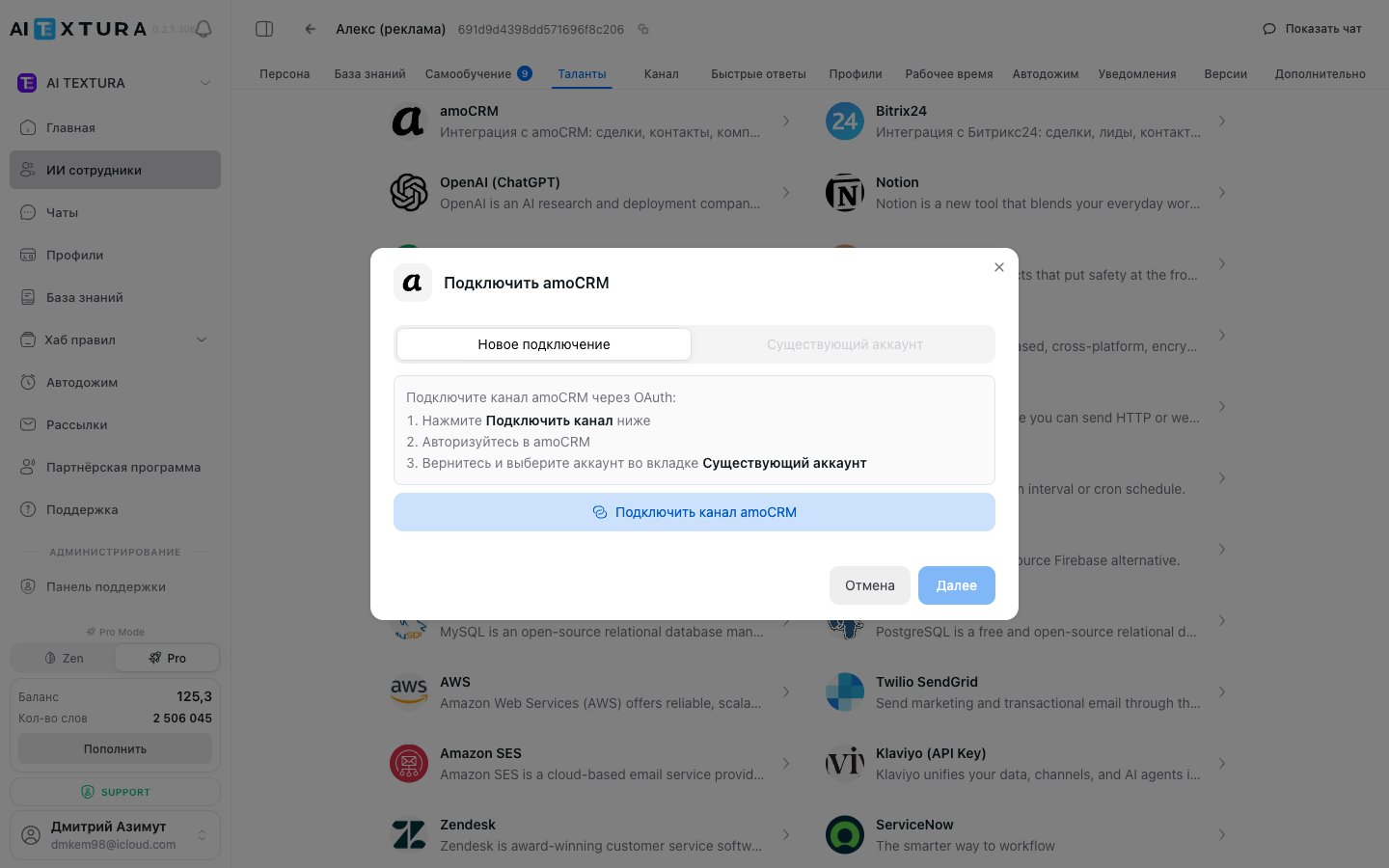
amoCRM connects via OAuth sign-in — no logins or keys to enter.
1
Open the amoCRM card
Find it in the talent catalog by searching for its name.
2
Choose an authorization method
New connection — the platform redirects you to the amoCRM sign-in page. Existing account — if you’ve authorized amoCRM before, select it from the list.
3
Sign in with the right account
The talent’s permissions equal that account’s permissions: sign in with one that has access to the pipeline you need.
4
Click Connect talent
The talent appears on the Connected subtab.
Check. Ask the employee in the test chat to submit a request — a deal should appear in amoCRM.
Like Bitrix24, amoCRM can also work as a channel — see Channels. The talent handles only actions in the CRM.
How to connect Kommo
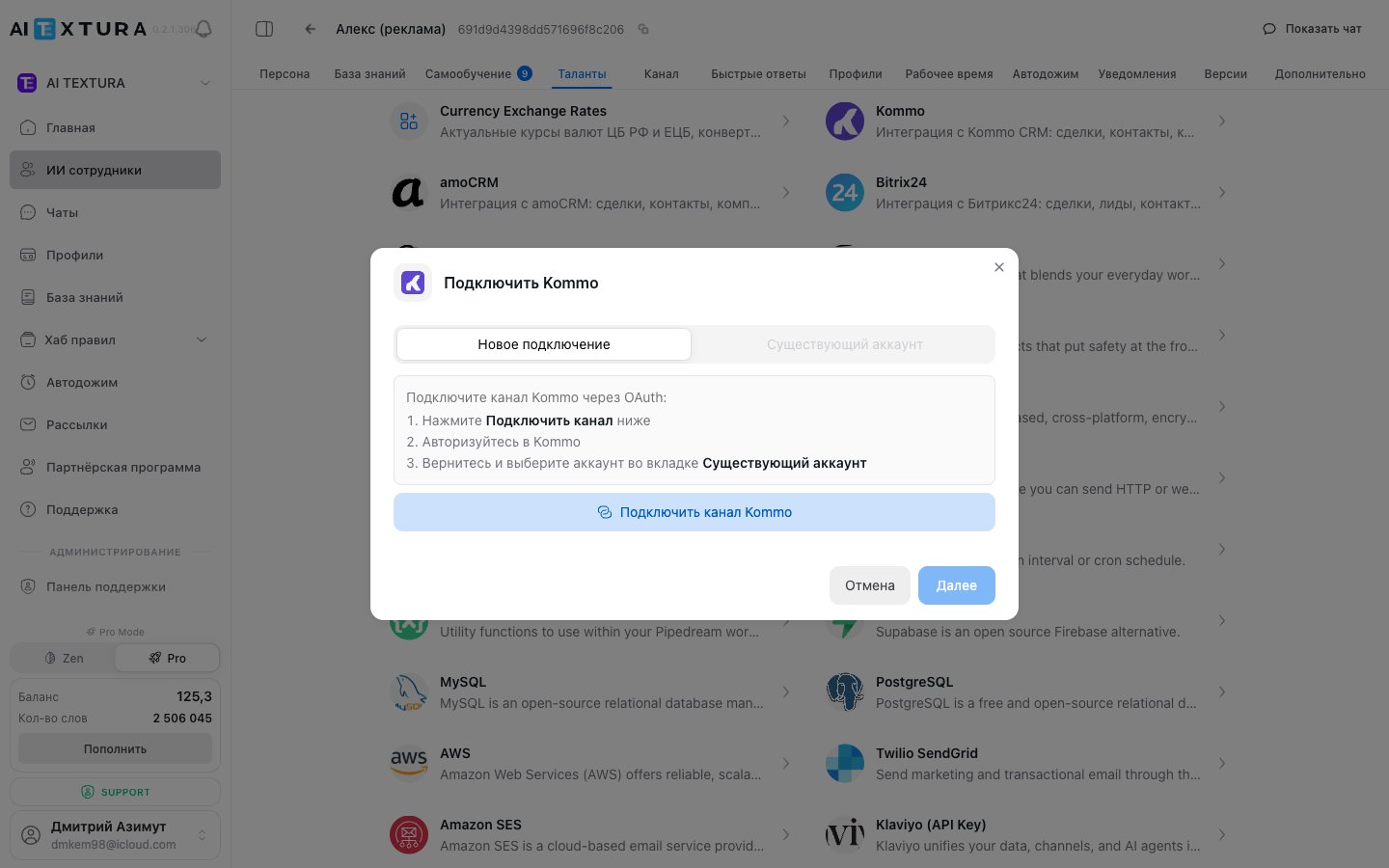
Kommo is the international version of amoCRM and connects the same way: New connection or Existing account, then an OAuth sign-in with an account that has access to the pipeline.
If the OAuth session expires, the talent stops working — reconnect it on the Connected subtab.
How to connect Salesforce, Zoho CRM, HubSpot, Zendesk, ServiceNow
Salesforce and Zoho CRM connect via OAuth sign-in; HubSpot, Zendesk, and ServiceNow connect with an API key from the service’s settings.The general order: card in the catalog → authorization or key → Connect talent. The talent’s permissions equal those of the account or key, so set up separate technical access with the minimum permissions required.
A PMS gives the employee your room inventory: available dates, room types, rates. Without it, the employee can’t answer “is anything available on November 5” or make a booking.
PMS
Region
Property type
How it connects
MEWS
Global
Hotels, hotel chains
Configuration ID + connector tokens
Travelline
Russia, Belarus, worldwide
Hotels
Hotel ID + region
Bnovo
Russia, CIS
Small hotels, guest houses
Hotel ID + login and password
RealtyCalendar
Russia
Apartments, short-term rentals
API key
Bronirui Online
Russia
Guest houses, mini-hotels
API key
MeHotel
Russia
Hotels, apartments
API key
PMS cards are on the Talents tab → App overview, under the Travel & Hospitality filter. A connected PMS lets the employee check available dates, show room types and rates, create a draft booking or pass the details to a manager, answer questions about an existing booking, and see the day’s arrivals and departures. The exact set depends on the specific system’s API and the account’s permissions.
PMS credentials give access to bookings, rates, and guest data. Create a separate technical account with the minimum permissions required: you can revoke it at any time without touching your working accounts.
How to connect Travelline
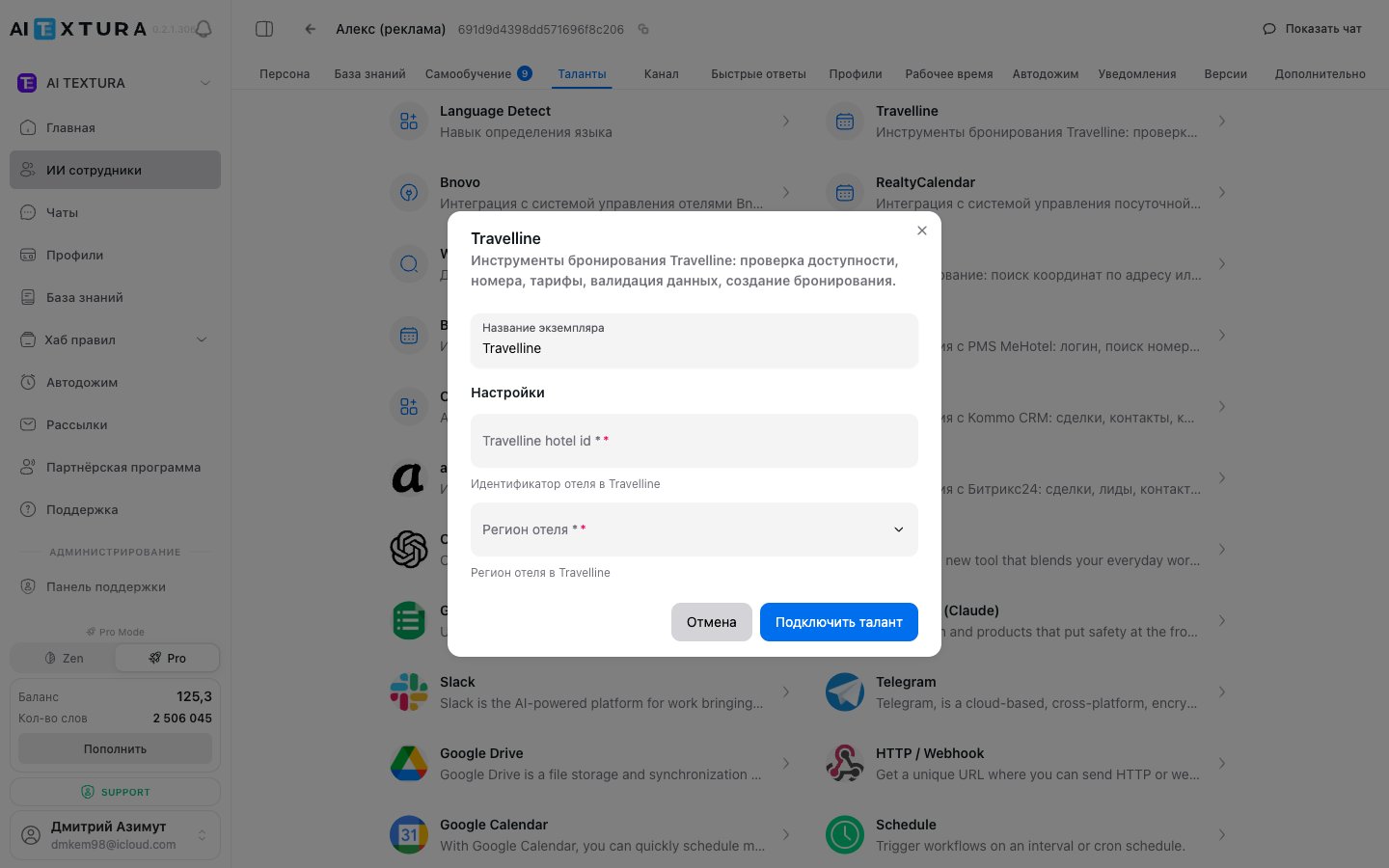
What you’ll need: the Hotel ID from your Travelline account and the region where the hotel operates.
1
Open the Travelline card
Talents tab → App overview → Travel & Hospitality filter, or search by name.
2
Fill in two fields
Hotel ID — the numeric ID from your Travelline account. Region — РФ (Russia), РБ (Belarus), or МИР (worldwide): this determines which Travelline server requests go to.
3
Name the instance
If you have several hotels, a name like “Travelline — Primorsky” will save you time later.
4
Click Connect talent
The talent appears on the Connected subtab.
Add a rule to the Persona — without it, the employee won’t query the PMS:
When a guest asks about available dates or room prices, check availability in Travelline and show the available options with prices.
Check. Ask in the test chat: “Is a room available from November 5 to 7?” The employee should reply with specific room types and prices.If the answer is vague:
“I can’t check availability” — check the Hotel ID and region, and also the account’s permissions in Travelline.
It answers about prices but not dates — the account lacks permission to read the calendar.
It doesn’t query the PMS at all — there’s no rule in the Persona.
How to connect Bnovo
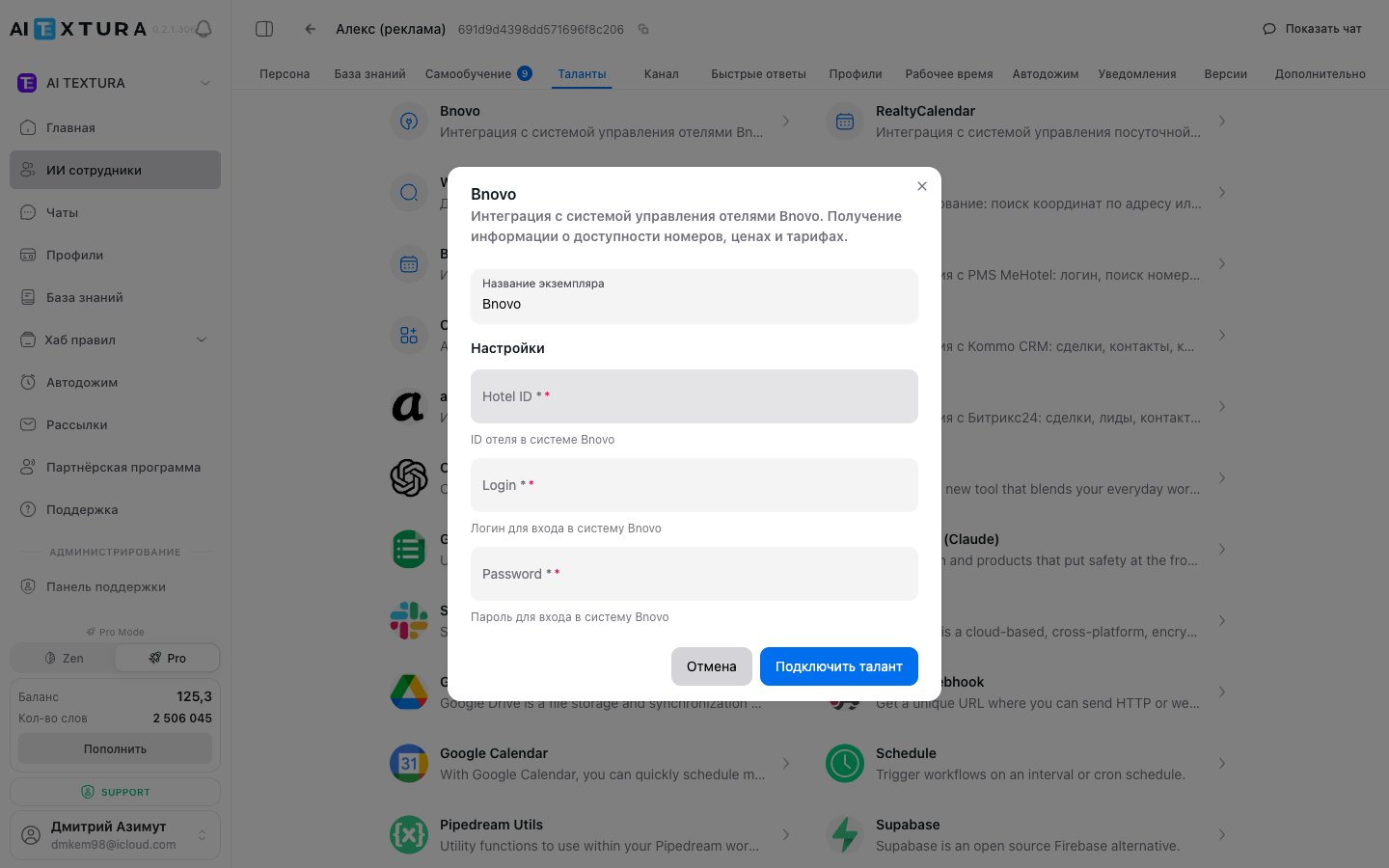
What you’ll need: the Hotel ID, plus the login and password of a Bnovo account.
1
Open the Bnovo card
Talent catalog → search by name.
2
Fill in three fields
Hotel ID — the property ID in Bnovo. Login and Password — the credentials of the account the employee will use to access the PMS.
3
Click Connect talent
The talent appears on the Connected subtab.
Create a separate technical account in Bnovo for the integration. That makes it easier to grant exactly the permissions needed and revoke access without touching working accounts.
Check. Ask about available dates in the test chat — the employee should return room types and prices from Bnovo.
How to connect MEWS
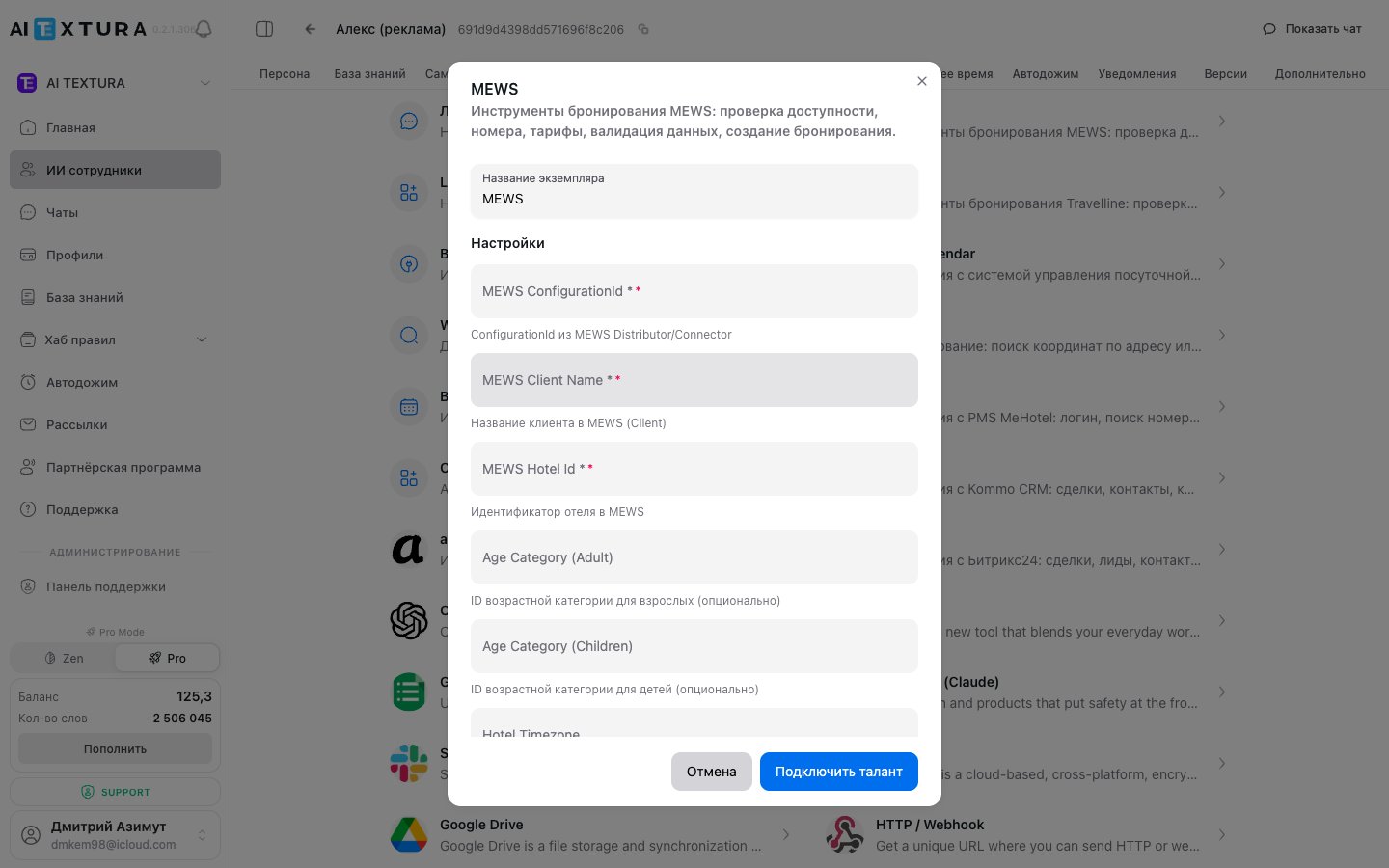
MEWS requires the most data, and nearly all of it comes from your MEWS partner manager: ask them for a configuration for the AI TEXTURA integration.What you’ll need:
Field
Where to get it
Configuration ID
Issued by MEWS for the specific integration
Client Name
MEWS settings
Hotel ID
MEWS settings
Age Category Adult and Children
Guest categories in MEWS
Hotel Timezone
Hotel settings
Connector Client Token, Access Token, Client
Issued by MEWS
Enterprise ID
MEWS settings, for chains
Fill in the fields on the MEWS card and click Connect talent. For a hotel chain, create a separate AI Employee for each hotel, each with its own Configuration ID and Hotel ID.
How to connect RealtyCalendar, Bronirui Online, MeHotel
All three connect the same way — with an API key from the system’s account dashboard.
1
Get an API key
In your RealtyCalendar, Bronirui Online, or MeHotel account — the settings or integrations section.
2
Paste the key into the talent card
The API Key field in the connection window.
3
Click Connect talent
Test it in the test chat by asking about available dates.
Each property needs its own talent instance and, as a rule, its own AI Employee. One employee with two PMSs will start mixing up properties.
Where to find the Hotel ID
In Travelline — in the hotel account, in the settings at the top right: a few digits like 243332. In Bnovo — in the account’s address bar: https://bnovo.ru/hotel/12345, where 12345 is the ID.
Bnovo: "no available hotels found" when connecting
The login or password was typed by hand and a space slipped in. Copy both values from Bnovo to the clipboard and paste them again. If the error persists, contact Support.
Bnovo: the employee quotes prices from inactive rates
It sees everything that’s open “at the front desk.” Configure rate visibility in Bnovo, or create a separate rate for the AI Employee and specify it in the Persona.
Bnovo: a booking was created with a total of 0 ₽
The price didn’t reach the PMS. Take it from the Bnovo notification email and enter it manually, then send the case to Support — the discrepancy is investigated using logs. Creating bookings via the Bnovo API isn’t available in every configuration yet: if you need it, check the status with Support.
MEWS: check-in time is shifted, and how often data updates
MEWS expects times in the hotel’s time zone, not UTC, so it’s important to set Hotel Timezone correctly in the talent settings. Availability and price data update every two minutes. MEWS grants access to its Connector API after the integration is certified — request it from your MEWS manager.
The employee asks for the guest's citizenship
It’s a required field in the Travelline booking form — the booking won’t be created without it. You can soften the wording of the question with a rule in the Persona.
Are promo codes applied when calculating the price?
No, promo codes aren’t applied automatically. Describe the promotion terms in the Persona — the employee will tell the guest about it, and a manager will apply it when finalizing the booking.
How to make the AI Employee the booking source instead of the website
This is configured on the Travelline side: ask their support to add AI TEXTURA as a separate booking source.
The employee doesn't send a payment link
Check three things in order: whether old context is being carried over — clear the conversation history and ask the guest to write again; whether a pay-at-check-in rate was selected — no link is created for it; whether a manager stepped in before the employee collected all the details. If everything looks fine, send a link to the conversation to Support.
The employee sent a link, but there's no booking in the PMS
That’s expected: the booking is recorded when the guest follows the link and confirms it. Until they do, nothing appears in the PMS.
The employee wrote "booked" when there's no booking
It paraphrased the fact that it collected the details. Replace the wording in the Persona with something precise: “Details passed to a manager” or “Booking link sent.”
The employee miscounts nights
State the rule directly: “A one-night booking spans two days: check-in and check-out. ‘From the 4th to the 6th’ is two nights, not three.” Add a rule about the year while you’re at it: “Book in the current year unless the guest specifies another.”
The employee fills in made-up names and phone numbers
Prohibit this in the Persona: “Never use made-up or test data for a booking. Always ask the guest for their real details.”
Multiple rooms, hourly bookings, early check-in
The employee doesn’t handle these itself: it passes multiple rooms, hourly stays, and extra services to a manager along with the collected details. Describe in the Persona how it phrases this, so the guest doesn’t think the booking is already done.
Our server is behind a firewall — what should we allow?
Allow access from the addresses 136.144.29.235 and 136.144.28.219 and from the aitextura.com domain.
What if your PMS isn't on the list
Contact Support — the catalog keeps growing. Alternatively, connect your own MCP server via Create talent — server type SSE or Streamable HTTP, with API key or Bearer token authorization.
Hotel chain: how to separate properties
Each hotel gets its own AI Employee with its own PMS talent, its own Knowledge Base, and its own Persona. You can still use a shared WhatsApp number or a single aggregator channel — it’s the employees you separate, not the channels.Technically, you can connect two PMSs to one employee, but it will start mixing up properties. If you have several properties, split them across employees.
Can the employee make bookings on its own?
Yes, if the talent has write permission and this is explicitly described in the Persona. Start with a “draft booking plus manager confirmation” scenario and move to full automation once you’re happy with the conversations.
After connecting a PMS, the employee needs three more things: a rule in the Persona for when to query the PMS; a channel to talk with the guest; and a Knowledge Base with the cancellation policy, breakfast details, and house rules — the PMS provides room figures, and everything else comes from there.
All Google services connect via OAuth sign-in: click the card, sign in to your Google account, and grant access. The talent’s permissions equal that account’s permissions — create a separate service account if you don’t want to expose your personal drive.If you have several calendars, create a separate AI Employee for each: the same talent can be connected to one employee only once.
How to connect Notion
Connect via OAuth. After signing in, select in Notion the pages and databases you want to share — the employee will see only those.
How to connect Stripe and other payment services
Stripe connects with an API key from the Stripe dashboard: Developers → API keys. Once connected, the employee can create payment links, check payment status, and issue refunds.
A key that can charge money is sensitive access. Use a key with the minimum permissions required and describe in the Persona the exact conditions under which the employee creates a payment link.
How to connect email services: SendGrid, Amazon SES, Klaviyo
All three connect with an API key from the service’s dashboard. The sender domain must be verified on the service’s side, or emails won’t be sent.
How to connect a database: PostgreSQL, MySQL, MongoDB, Supabase
You’ll need the server address, port, database name, login, and password. Supabase connects with the project URL and a service key.
Give the account read-only access if the employee only needs to look up data, not change it. An open database is the most expensive way to make a mistake.